

Key Highlights
Here are the key takeaways from our discussion on what doctors might be missing about scoliosis:
- Early Detection is Key: Many doctors and school nurses miss the early signs of scoliosis, especially mild scoliosis, during routine screenings.
- “Watch and Wait” Isn’t Enough: The traditional approach of monitoring a curve without proactive treatment can allow adolescent idiopathic scoliosis to worsen.
- Parents Play a Vital Role: Knowing the subtle signs of scoliosis, like uneven shoulders or how clothes fit, helps ensure early detection.
- Proactive Treatments Exist: Innovative, exercise-based approaches can manage spinal curvature without waiting for it to progress.
- Functional Medicine Offers a Different View: This approach seeks to understand the root cause of the condition, not just manage the symptoms.

Introduction
It can be a shock to learn that your child’s scoliosis might be missed during routine checkups. Many parents trust that standard pediatric visits will catch conditions like adolescent idiopathic scoliosis, but mild cases often fly under the radar. Without proper screening and early identification, a child’s scoliosis can progress significantly, leading to more invasive scoliosis treatment options down the road. This article explores why scoliosis is sometimes overlooked and what proactive steps you can take to ensure your child gets the right care.
Updates on Scoliosis Etiology: What Has Changed?
For a long time, the root cause of most scoliosis cases, particularly adolescent idiopathic scoliosis, has been labeled “unknown.” This has led to a common misconception among doctors that the only option is to watch and wait for progression. This passive approach often means missing a crucial window for early, non-invasive intervention.
Recent thinking challenges this outdated philosophy. The focus is shifting from simple observation to understanding the underlying factors that contribute to spinal curvature. This new perspective emphasizes that even if the exact cause is unclear, we can still take proactive steps to manage the condition and prevent it from worsening. Let’s look at what the latest research reveals and why doctors might not be catching the signs.
A recent article, “Updates on Scoliosis Etiology,” offers a detailed summary of the latest scientific understanding of adolescent idiopathic scoliosis. It explores the genetic, hormonal, and biomechanical factors that are now believed to contribute to the condition’s onset and progression. You can read the full article here.
This research highlights that scoliosis is far more complex than just a sideways curve. It’s a three-dimensional condition often linked to the central nervous system and how the body communicates with the brain. The article discusses how these new insights challenge the traditional “watch and wait” model that often leads to bracing or spinal fusion for severe scoliosis.
By understanding these updates, it becomes clear why some doctors, who may not be up-to-date on this specific research (doi: 10.1186/s13013-019-0215-4), might overlook the importance of early, proactive treatment. Their focus may remain on the curve’s measurement rather than the underlying causes of its progression.

Why Doctors May Overlook Early Indicators of Scoliosis
It’s concerning, but doctors and school nurses can miss the early signs of scoliosis. One reason is that screenings can be rushed. The standard Adam’s forward bend test, where a child bends at the waist, might only catch more obvious curves. Subtle asymmetry in the lower back or slight imbalances can easily be overlooked in a quick visual check.
Another issue is the inconsistency of screening tools. While a scoliometer can measure trunk rotation and provide a more accurate assessment, many pediatricians don’t use it regularly. This reliance on visual observation alone makes it difficult to achieve reliable early detection, especially for mild curves that haven’t progressed significantly.
Here are some signs that might be missed during a standard checkup:
- Slightly uneven shoulders or shoulder blades.
- One side of the waist appearing more curved.
- A minor difference in how the arms hang by the sides.
- Changes in the skin along the spine, like dimples or discoloration.
Innovative Approaches to Scoliosis: Beyond Traditional Care
Instead of waiting for scoliosis cases to worsen, innovative approaches focus on proactive treatment from the moment of diagnosis. This philosophy challenges the old “watch and wait” method, which often allows progression to occur and can lead to discomfort and more significant posture problems. The goal is to act early to manage the condition effectively.
These modern methods use targeted exercises and tools to address the root imbalances causing the curve. This can help improve posture, reduce the risk of progression, and empower patients to take control of their health without waiting for the condition to become more severe. Below, we’ll look at the ScoliSMART approach and how it provides a different path.

The ScoliSMART Approach and Scoliosis Boot Camp
The ScoliSMART approach differs significantly from traditional scoliosis treatment. Instead of relying on passive methods like a conventional brace or waiting for curves to worsen, it uses targeted, exercise-based programs. This is an alternative that many mainstream doctors don’t mention, often because their training is focused on bracing and surgery.
A key part of this method is the Scoliosis Boot Camp. This intensive program uses specialized exercises and equipment to retrain the brain and muscles to support a straighter spine. The ScoliSMART approach is designed to be proactive, especially during critical growth spurts when curves are most likely to progress.

The ScoliSMART philosophy centers on:
- Early Intervention: Starting treatment as soon as a curve is detected.
- Targeted Exercises: Using specific movements to correct postural imbalances.
- Avoiding Bracing and Surgery: Providing an effective alternative to more invasive treatments.
This approach offers a powerful alternative to traditional physical therapy, focusing on neuro-muscular re-education rather than just muscle strengthening.
How the ScoliSMART Activity Suit Supports Better Outcomes
To address gaps in care, patients can explore tools like the ScoliSMART Activity Suit. This innovative suit is not a traditional, rigid brace. Instead, it’s a dynamic garment worn during daily activities that helps create a new, corrected muscle memory for your body. It provides a constant, gentle reminder to your muscles and brain to maintain a better posture.
The suit works by creating a new postural feedback loop. As you move, it stimulates your muscles to work against the curve, effectively turning everyday motion into a form of active treatment. This helps reduce the risk of progression and can lead to measurable improvements in spinal alignment without the discomfort and restrictions of a hard brace.
By incorporating the ScoliSMART Activity Suit into a treatment plan, you are taking a proactive step. This is a perfect example of how to address the shortcomings of a “watch and wait” approach. It offers a form of early intervention that actively works to improve posture and halt progression, empowering you to manage your scoliosis on your own terms.

Alternative Methods and Functional Medicine Perspectives
Functional medicine offers a completely different lens for viewing scoliosis cases. Instead of just treating the abnormal spinal curvature as the problem, it seeks to understand the root cause. This approach asks why the spine is curving in the first place, looking at factors like genetics, hormones, and nutrient deficiencies that mainstream medicine often overlooks.
The goal of functional medicine is to find and address the underlying imbalances that contribute to the condition’s progression. This focus on early intervention and root-cause analysis is a significant departure from the symptom-based management common in traditional care. Let’s compare how functional medicine and mainstream doctors approach scoliosis.
The best doctor for treating scoliosis is one who aligns with your treatment goals. Functional medicine practitioners and mainstream doctors have fundamentally different approaches to this progressive condition. Mainstream doctors typically follow a path of observation for mild scoliosis, recommending a brace or surgery only when the curve becomes severe. Their primary focus is on managing the curve itself.
In contrast, functional medicine doctors dig deeper. They aim for early detection of underlying issues that could be driving the scoliosis, such as hormonal imbalances or nutrient deficiencies. Their treatment plans are highly individualized and aim to correct these root causes to stop the curve from progressing naturally.

This table highlights the key differences:
| Feature | Mainstream Doctors | Functional Medicine Doctors |
| Primary Focus | Managing the spinal curve’s progression. | Identifying and treating the root cause of scoliosis. |
| Approach | “Watch and wait,” followed by bracing or surgery. | Proactive, whole-body approach from diagnosis. |
| Treatment Tools | Observation, bracing, surgery. | Nutrient therapy, hormone testing, targeted exercises. |
| Goal | Stop the curve from getting worse. | Correct underlying imbalances to improve overall health and halt progression naturally. |
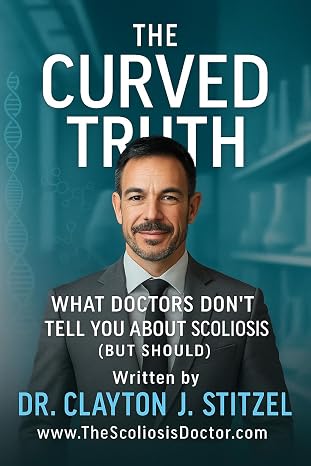
The Curved Truth: What Doctors Don’t Tell You About Scoliosis
Many people feel let down when they realize their doctors may have missed or misunderstood their scoliosis. The traditional medical path often presents a limited set of options: watch the spinal curvature during adolescence, wear a brace, or undergo spinal fusion if progression is severe. This narrow view can leave patients and parents feeling powerless.
What doctors often don’t discuss are the proactive, non-surgical options that can be implemented from the very beginning. A new book aims to shed light on these alternatives and empower families with the knowledge to make more informed decisions about their care.
Discover hope, science, and real solutions—explore The Scoliosis Doctor series on Amazon and start transforming your scoliosis journey today! Download the Kindle app on your mobile device for free! Get it for iPhone. Get it for Android.
Key Takeaways from Dr. Clayton J. Stitzel’s Book
In his book, “The Curved Truth: What Doctors Don’t Tell You About Scoliosis (But Should),” Dr. Clayton J. Stitzel pulls back the curtain on the conventional treatment of a child’s scoliosis. The book is a guide for parents who feel there must be a better way than simply waiting for a curve to worsen. It addresses the common feelings of frustration and provides a roadmap for proactive treatment.
The book emphasizes that the “watch and wait” approach is fundamentally flawed because it allows the condition to progress. Dr. Stitzel argues that by the time a brace is recommended, a critical window for less invasive intervention has already been missed. He highlights that even adults who went undiagnosed can find answers, as the book explains how subtle signs of scoliosis were likely missed in their youth.

Key takeaways include:
- Why the “watch and wait” approach often fails.
- How to identify subtle signs of scoliosis that doctors might miss.
- The truth about bracing and its limitations.
- Proactive, natural strategies to prevent further curvature and avoid surgery.
Conclusion
In conclusion, understanding the latest updates on scoliosis can significantly alter how we approach this condition. This article highlights key insights from recent research and innovative approaches that go beyond traditional care, shedding light on potential oversights by mainstream doctors. We also introduced Dr. Clayton J. Stitzel’s enlightening book, “The Curved Truth,” which offers a fresh perspective on what is often not discussed in conventional medical settings. By embracing these insights, we can foster better awareness and improve outcomes for those affected by scoliosis. For further details, be sure to check out the full article here. If you’re eager to dive deeper into these revelations, consider exploring Dr. Stitzel’s book for a comprehensive understanding.


